 Let's
Let's The First Game Night After Moving: New Group, New Dynamic
New city, new people, no idea if any of them even liked board games. Spoiler: nobody wanted to leave at the end.
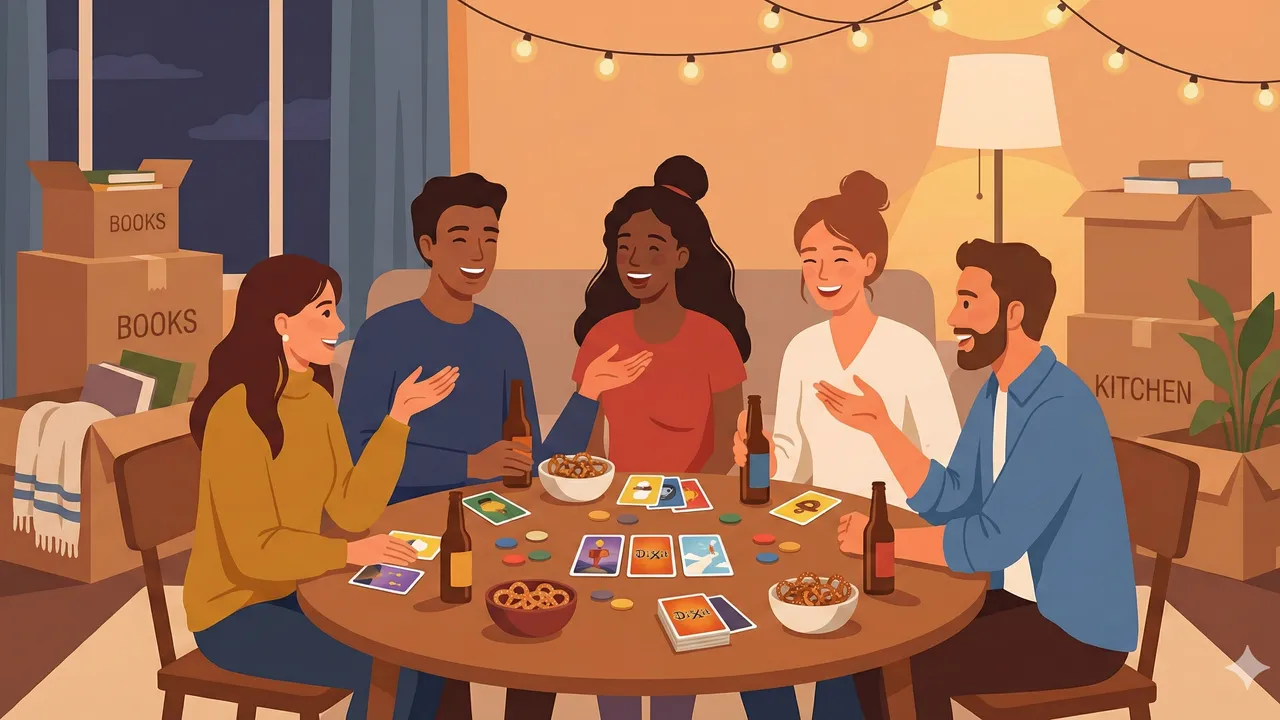
The Invitation
Three weeks after moving. Most of the boxes were unpacked (or at least pushed into the right corner), the kitchen was more or less functional, and I knew exactly four people in the new city: my landlady, the woman from the bakery on the corner, a colleague from my new job, and his girlfriend. That was it.
So I did what I always do when the walls start closing in: I organised a game night.
My message to my colleague Nils went something like: "Hey, I have a flat, some games, and too much wine sitting on the shelf. Want to come over Friday evening? Feel free to bring people." Sounds relaxed. It wasn't. I rewrote the message three times. The last thing you want is to come across as the odd new person who invites grown adults to a board game night.
Nils said yes straight away and brought three more people: his girlfriend Janna, his flatmate Marco, and Marco's friend Dennis. Five people in total, nobody knew everyone, but everyone knew at least one person. A perfect setup for an interesting group dynamic. Or for total silence. You never really know in advance.
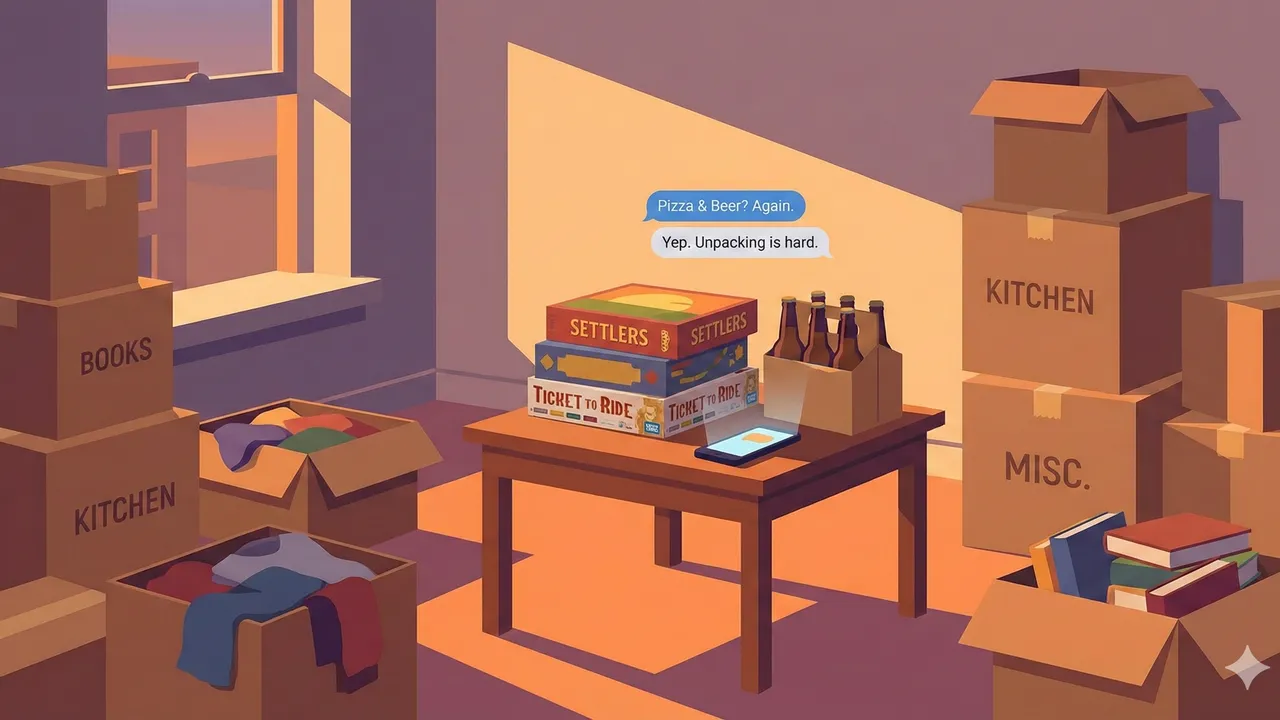
What do you play with strangers?
That is the real question. With my old group I knew exactly what worked. Lisa doesn't like bluffing games, Stefan hates losing, Sarah needs complex rules or she gets bored. But with a completely new group? No idea.
I didn't know whether they even liked board games at all. Whether they were more competitive or cooperative by nature. Whether someone would get frustrated quickly, or whether there was a closet strategy nerd who pictured something like Snakes and Ladders when they heard the words "game night."
I set three ground rules for myself beforehand:
- Nothing complicated. If the rules explanation takes more than three minutes, you lose people who haven't yet decided whether they even want to stay.
- Games that generate conversation. Making small talk with strangers is exhausting. Games that naturally supply something to talk about take the pressure off.
- No hard head-to-head competition. Nothing kills the atmosphere faster than a new colleague strategically dismantling you in round three, knowing you'll be sitting next to each other in the office on Monday.
What worked
Dixit as the opener
I had been deliberating for a while over what to start with. Dixit was a gut feeling. And it was exactly right.
For anyone who doesn't know it: you hold cards with surreal illustrations. The active person says a word or sentence to describe one of their cards, then everyone else secretly plays a card they think fits. All cards are revealed and everyone guesses which was the original.
What makes it special with new people: you find out immediately how someone thinks. Janna described a card showing a forest full of eyes as "Monday morning on the train." Dennis described floating fish as "when my grandma cooks." By that point the ice was broken. You laugh at the associations, ask follow-up questions, share little stories. The game almost becomes secondary.
Marco, who had been fairly quiet up to that point, really opened up during Dixit. His descriptions were so unexpected ("the sound you make when you step on Lego" for a card showing a volcano) that at some point everyone was waiting for his turn.
- You learn immediately how others think
- No prior knowledge needed
- Beautifully illustrated cards
- Only works with 4+ players
- Quieter personalities have a harder time
Let's Fib in between

At some point Dennis asked whether we could play something on our phones. I had already tried Let's Fib with my old group and knew it works particularly well with new people: you get questions, invent wrong answers and try to trick the others into choosing them. All in the browser, no download, everyone is in within 30 seconds.
What makes it so good for a getting-to-know-you evening: you immediately see who has what kind of sense of humour. Janna consistently wrote the most subtle answers, the ones that almost sounded correct. Nils, on the other hand, typed such obvious nonsense that everyone was already laughing before the vote was even in. And that is exactly what you want on an evening like this. If you are looking for more no-prep party games for spontaneous sessions, we have a whole list.
- Zero setup, runs in the browser
- Everyone plays at the same time
- Perfect for getting to know people
- Everyone needs a phone
Skull as a warm-up
After Dixit I brought out Skull. The simplest bluffing game there is: everyone has four discs, three with flowers and one with a skull. You lay one disc face down, then players take turns bidding on how many discs they can flip without hitting a skull.
Rules explanation: 90 seconds. Genuinely.
Skull works with new people for one simple reason: bluffing is personal. You look someone in the eyes and try to work out whether they're lying. And it doesn't feel mean. When someone gets caught out, everyone laughs. When a good bluff gets through, there are appreciative comments all round.
Nils turned out to be a master bluffer. Three rounds in a row he laid the skull, smiled innocently, and caught everyone out. On the third time Dennis looked at him and said: "I don't believe a word you say. But I'm flipping it anyway." Of course it was the skull. The reaction around the table was priceless.
Those are the moments that carry a game night. And I had them here with people I had met for the first time three hours earlier.
- Rules explained in 2 minutes
- Bluffing gets everyone laughing
- Compact, fits anywhere
- Maximum 6 players

Wavelength for the discussions
I brought Wavelength out as the third game, and it was the moment the evening shifted from a game night into a real evening among friends.
The idea: there is a scale between two opposites (for example "Underrated" and "Overrated"). One person can see where on the scale the dial is pointing and gives a clue. Everyone else discusses where the dial might be.
The scale was "Overrated" to "Underrated." Marco's clue: "Going out for breakfast." What followed was a ten-minute debate. Janna thought it was completely overrated ("twelve euros for scrambled eggs and toast that I could make at home for two"). Dennis thought it was underrated ("it's about the experience, not the food"). Nils was somewhere in the middle. And Marco just grinned, because he knew exactly that he had thrown a grenade into the room.
The game revealed things about people that a normal getting-to-know-you conversation would never have turned up. Whether someone prefers dogs or cats, how they feel about overtime, whether pineapple belongs on pizza. Wavelength is less a game than a getting-to-know-you format in disguise.
- Sparks discussion immediately
- Everyone has an opinion
- Works with larger groups too
- Needs people who like to talk
The Mind to close things out
That was an experiment. The Mind is cooperative, wordless, and essentially the opposite of everything that had worked that evening. You lay number cards in ascending order together. Without talking. Without giving signals. Purely by instinct.
I wasn't sure whether it would work with people who had only known each other for a few hours. You need a sense of each other for it, a feel for when someone is about to play a card.
It worked. Not immediately. The first two rounds were shaky, with a lot of nervous laughter. But by the third round something interesting happened: we started reading each other. Janna would raise her eyebrows slightly just before she played. Dennis breathed faster when he held low numbers. And when we managed to get all the cards in the right order in level six for the first time, we cheered as if we'd won a final. Five near-strangers celebrating together. A genuinely lovely moment.
- Cooperative, no competing against each other
- Builds a real sense of group connection
- Minimal rules
- Maximum 4 players
- Some people find it boring
What didn't land
Azul: beautiful game, wrong moment
I had Azul out on the table too. Gorgeous tiles, wonderful to hold, one of my favourite games. But for this particular evening it was the wrong choice.
We started a round and after ten minutes noticed: everyone had gone quiet. Each person staring at their own board. Occasionally someone reaches into the centre and takes tiles. No conversation, no laughter, no exchange. The game pulls you too far into your own head.
Marco said after 15 minutes: "This is actually really good, but I miss the discussions we were having before." He was right. We finished the round (Dennis won and was visibly pleased with himself) and then switched to Wavelength. The energy came back immediately.
Azul is a wonderful game. Just not when you're getting to know each other. It needs interaction, and Azul offers almost none.
- The feel of the tiles is wonderful
- Tactical without being complicated
- Too quiet for a getting-to-know-you evening
- Maximum 4 players
What I learned
That evening showed me a few things I hadn't thought about beforehand:
Games are better than small talk. The usual questions ("What do you do?", "How are you finding the city?") produce surface-level answers. But when someone describes a burning tree at Dixit as "my ex," you suddenly find yourself in a real conversation.
Simple rules are non-negotiable. If someone is at your place for the first time and isn't sure whether game nights are their thing, you have roughly three minutes of rules explanation before their attention drifts. Skull took 90 seconds. Dixit maybe two minutes. That is the right frame.
Cooperative before competitive. At least to start. The Mind and Dixit carried the evening because nobody could really lose. Skull was the exception, but bluffing feels different from being strategically dismantled by someone.
Order matters. Something light and creative to open (Dixit), then something quick to loosen things up (Let's Fib, Skull), then something with more depth (Wavelength), and finally something calm to wind down (The Mind). If I had started with The Mind, the evening would probably have been over after an hour.
The evening went until half past one. When Nils and the others were leaving, Janna said in the doorway: "Same time next week?" Same time next week. Three weeks in the new city and I had a regular game night. Sometimes you really don't need more than that. For more tips on putting an evening together, our guide on how to plan a game night covers everything you need.
If you've recently moved or are meeting new people: invite them over. Get Dixit and Skull. Have snacks ready (something that isn't too sticky, we have experience with that). And don't stress about it. The games handle the hard part.
You might also like

 Nina
7 min read
Nina
7 min read
Making Your Own Game Cards: Crafting, Printing and the Road to Your Own Card Game
How we started making and printing our own game cards. With kids, a laminator, and more ambition than planned.
Read more →
 Stefan
6 min read
Stefan
6 min read
Why Every Board Game Seems to Be "Game of the Year"
Every box in the store carries that red logo. But what's actually behind Germany's Spiel des Jahres, how many games really get the award, and is it worth buying by the sticker?
Read more →
 Ayla
5 min read
Ayla
5 min read
The Game Night Nobody Wanted
Everyone wanted to cancel, nobody had the energy, and in the end it was one of the best evenings in months. Why showing up is always worth it.
Read more →