 Let's
Let's Why Every Board Game Seems to Be "Game of the Year"
In every board game store, that red logo is on seemingly every other box. What Spiel des Jahres actually means, why so many games get to advertise it, and whether it's worth buying by the sticker.

The Shelf of Winners
Last week I was at the local board game shop with Markus. We wanted to pick up something new for our next game night. Nothing specific, just browsing.
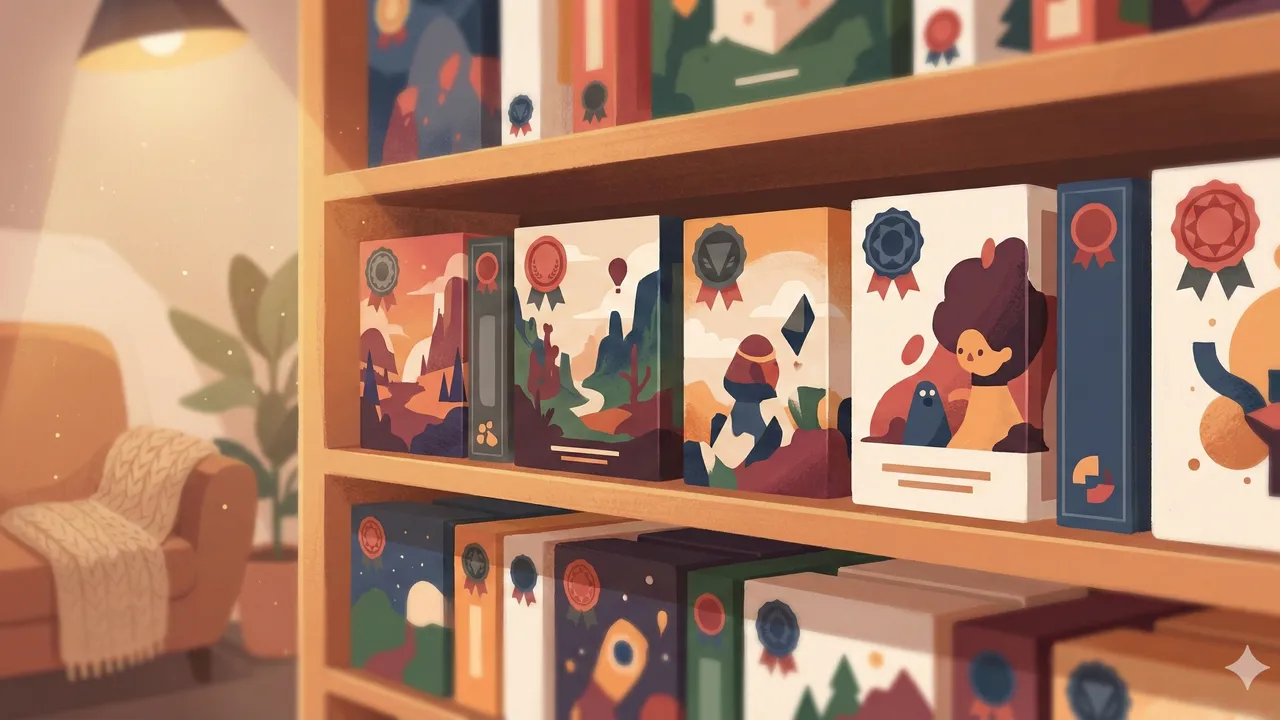
And then we were standing in front of the shelf and Markus said the sentence that started this whole article: "Is literally every game here Game of the Year?"
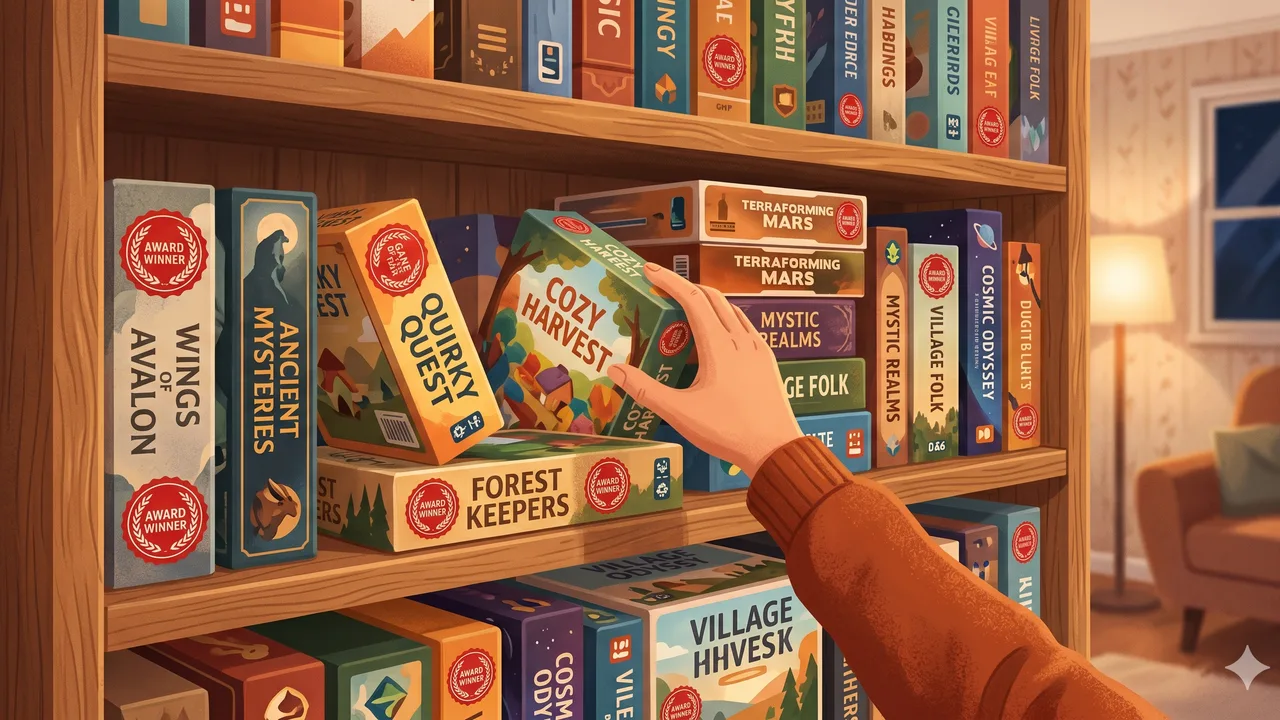
I wanted to argue. Then I actually looked. Catan: Spiel des Jahres. Carcassonne: Spiel des Jahres. Cascadia: Spiel des Jahres. Azul: Spiel des Jahres. Just One: Spiel des Jahres. Dorfromantik: Spiel des Jahres. And then boxes with "Nominated for Spiel des Jahres" and "Spiel des Jahres Recommended." Red logo, grey logo, blue logo. Logos everywhere.
Markus wasn't wrong. It really does feel like every other game has won some kind of award. And I found myself wondering: what does it actually mean? Is it a genuine seal of quality or more like "dentist recommended" on toothpaste?
What Spiel des Jahres Actually Is
So I did some research. (Yes, I do that sometimes. Doesn't happen often, but when it does, I go all in.)
The Spiel des Jahres (literally "Game of the Year") has been around since 1979. An independent jury of game critics (journalists, not publishers) reviews each year's new releases and picks a winner. Since 2001 there's also the Kinderspiel des Jahres (Children's Game of the Year), and since 2011 the Kennerspiel des Jahres (Connoisseur's Game of the Year, for the more complex stuff). Three categories total.
The jury currently has ten to fifteen members. They meet throughout the year, play everything that hits the market, discuss, presumably argue, and then nominate three games per category in early summer. The winner is chosen from the nominees in July.
What surprised me: the jury evaluates between 300 and 400 new releases per year. Three hundred. And out of those, three get nominated and one wins. Those are pretty serious odds.
But here's the bit that explains why everything in Markus' shelf is glowing red.
Why the Logo Is Everywhere
Besides the three nominees per category, there's the so-called Recommendation List. These are games that didn't make the top 3 but were still good enough for the jury to explicitly recommend. Each category puts another four to six games on that list.
Let's do the maths. Three categories, each with three nominees plus five recommended. That's roughly 24 games per year that get to carry some kind of Spiel des Jahres sticker. And the logos all look similar. The winner gets the red logo. The nominees also get a logo (dark grey). The recommended ones get one too. For most people in the shop, it all looks the same.
And then it adds up over the years. The Spiel des Jahres has been around for 47 years. That's 47 winners in the main category alone. Plus nominees. Plus recommended. Plus Children's and Connoisseur's since 2001 and 2011 respectively. Over the decades, that's hundreds of games that get to carry a logo.
Catan won in 1995. Carcassonne in 2001. Dixit in 2010. Azul in 2018. Just One in 2019. Pictures in 2020. MicroMacro in 2021. Cascadia in 2022. Dorfromantik in 2023. Sky Team in 2024. All those games that sit in every shop? Nearly all Spiel des Jahres winners. No wonder it feels like "everyone's won."
The Business Side
What I found especially interesting: the logo isn't just an honour. It's serious business.
A game that wins the main prize sells roughly ten times as many copies as before. Ten times. That's not a small effect. For small publishers, that can be the difference between "we keep going" and "we shut down." And even a nomination or a spot on the Recommendation List brings noticeably more sales.
That's why publishers advertise it so aggressively. Every box that ever had any kind of connection to the award in any category gets the logo slapped on. And it's big. That's understandable. I'd do the same thing.
What sets this apart from "dentist recommended" on toothpaste: the jury is truly independent. No advertising, no sponsorship from publishers. The critics sometimes buy the games themselves. That's pretty rare in the awards landscape and one reason why the prize has carried weight for decades.
By the way: the Spiel des Jahres isn't a purely German phenomenon. In France there's the As d'Or (Jeu de l'Annee), in Austria the Spiel der Spiele, in Denmark the Guldbrikken, and in the Netherlands the Nederlandse Spellenprijs. Then there's the Deutscher Spiele Preis (voted by players, not a jury) and the Graf Ludo for best artwork. Internationally, the International Gamers Award is well known. But none of these come even close to the impact of the red logo. In Germany (and honestly, well beyond) "Spiel des Jahres" is essentially a synonym for "good board game."
Which SdJ Winners Are Worth It
Now for the actually important question: can you just buy blindly by the logo?
Short answer: mostly yes. But not always. The Spiel des Jahres is aimed at families and casual gamers. That means: the winners are nearly always accessible, fairly quick to explain, and don't last longer than an hour. Not a game for hardcore strategists (that's what the Kennerspiel des Jahres is for).
What impresses me: the recent years have been really strong. Sky Team (2024) is a pure two-player game where you have to land a plane together without being allowed to talk. Dorfromantik (2023) you might know as a video game, and the board game version is just as meditative. And MicroMacro (2021) is basically a giant hidden-object picture where you solve crimes. The jury is taking risks, and you can tell.
From our group, three SdJ winners have become absolute staples:
Cascadia
Cascadia won in 2022 and has been our most-played game since. You place landscape tiles and settle animals on them. Bears, salmon, hawks, elk, foxes. Each species wants to be arranged differently. Sounds like a nature class, but plays like a relaxed puzzle where you're constantly making small decisions.
What sets Cascadia apart from other SdJ winners: it genuinely works equally well with any player count. Solo on a Sunday morning (yes, I'm the kind of person who plays board games alone, don't judge), with Sarah as a pair, or with four on game night. Markus thinks it's "too peaceful" (of course he does), but that's exactly the point. Not every game needs confrontation. Sometimes you just want to place salmon in a river and drink your beer.
- Puzzly, relaxed, and still engaging
- Works equally well solo, with two, or with four
- Nature theme that actually fits the gameplay
- 4 players max
- Too peaceful for those who want confrontation
Just One
Just One won in 2019 and has been our go-to opener ever since. One person has a word, everyone else writes a clue. Matching clues get eliminated. Done.
Sounds simple? It is. And that's exactly the point. Sarah played it at Christmas with her family. Including Grandma. Grandma won the third round. Jens claimed Grandma's clues were "unfairly good." (They were just good. Jens is a sore loser, even in cooperative games.)
What makes Just One special: it's cooperative. You play together, not against each other. No frustration, no "you only won because you got lucky." Everyone's happy when it works, everyone laughs when it doesn't. Perfect for mixed groups where not everyone's at the same gaming level.
- Zero setup, play instantly
- Cooperative, no arguments
- Works with people who "don't play games"
- 7 players max
- Can get repetitive with the same group
Azul
Azul won in 2018 and I completely ignored it at the time. "Laying tiles? Seriously?" Well. Sarah brought it over at some point and now it's one of our most-played games.
You take colourful tiles from shared plates and place them on a pattern. Sounds harmless, right? Until you realise you're simultaneously planning what you take AND what you leave for your opponent. Markus figured that out by game three and has been insufferable since. "I took the yellow ones away from you." Yes, Markus. Thanks. We all saw that.
What surprised me about Azul: it looks fantastic. The tiles feel great, the board is beautiful, and when you're done, your pattern actually looks like something. In a world of ugly cardboard boxes, that's a genuine selling point.
- Tactical but quick to learn
- The tiles feel amazing in your hands
- Every game in under an hour
- 4 players max
- Can drag with slow thinkers
Buying by the Logo?
Back to Markus' question in the shop. Is every game Spiel des Jahres? No. But a surprising number of them are. And that's not because the award is handed out like confetti, but because it's been around for nearly 50 years and recognises nominees and recommended games alongside the winner.
Is the logo a reason to buy? For me: yes. Not blindly, but as a first compass. In 47 years of Spiel des Jahres, maybe two winners haven't clicked with me. That's a better hit rate than any other purchasing decision I make. (My last pair of shoes? Had no award. You can tell.)
What I do since that day at the shop: I check whether a game is a winner, nominated, or recommended. Winners and nominees are almost always a safe bet. The Recommendation List is worth a closer look, because those games can be more niche.
If you want to try something completely different at your next game night: with Let's Fib, you write creative fake answers to real questions and try to fool the others. No Game of the Year logo needed, works with 1–20+ people right in the browser.
- Zero setup, runs in the browser
- Creative bluffing instead of learning rules
- Works with any group size
- Everyone needs a phone with internet
And if you ask Markus: we bought Cascadia that day. Without the logo, we probably wouldn't have touched it. And it's now one of our favourite games. Full stop.
More ideas for no-prep party games and tips on planning a game night in our other articles.
You might also like
 Nina
7 min read
Nina
7 min read
Making Your Own Game Cards: Crafting, Printing and the Road to Your Own Card Game
How we started making and printing our own game cards. With kids, a laminator, and more ambition than planned.
Read more →
 Ayla
5 min read
Ayla
5 min read
The Game Night Nobody Wanted
Everyone wanted to cancel, nobody had the energy, and in the end it was one of the best evenings in months. Why showing up is always worth it.
Read more → Ayla
6 min read
Ayla
6 min read
Playing Games Over Video Call: Does It Actually Work?
Game night over Zoom when not everyone can be there in person. What works, what fails, and why some games actually play better remotely.
Read more →