 Let's
Let's Game Night with the In-Laws at Christmas: A Survival Report
My father-in-law voluntarily played a game invented after 2005 for the first time in his life at Christmas. I'm still in shock.
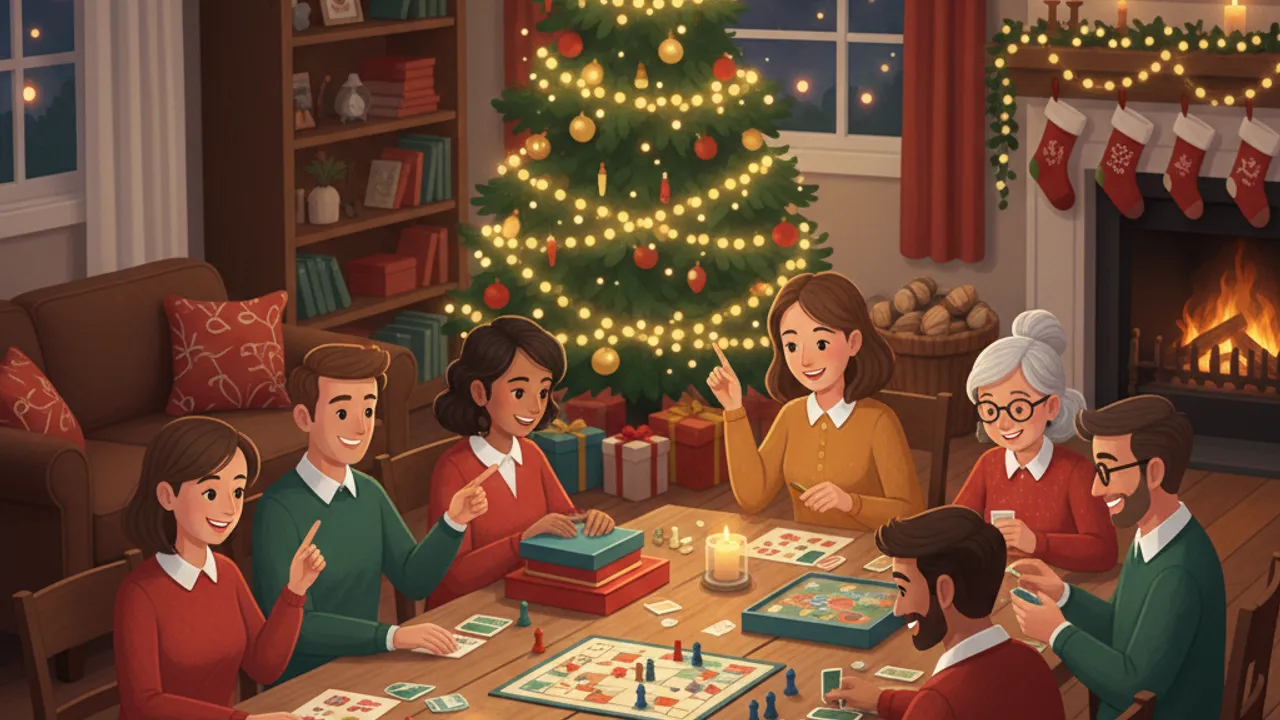
The Starting Situation
Okay, quick disclaimer: I was genuinely terrified of this evening. Not full-blown panic, more that gnawing feeling you get when you know you're about to suggest something that could go completely sideways. Like suggesting karaoke when you don't know the crowd. Except worse, because in-laws.
Sarah's parents were staying with us over Christmas. Gisela and Hartmut. (I've been calling them by their first names for three years and it still feels wrong. Every time I say "Hartmut" it sounds like a question in my head.) Gisela likes to play Rummikub. And ONLY Rummikub. That's her entire gaming repertoire. Hartmut doesn't play at all. Hartmut sits nearby, drinks his beer, and occasionally drops a comment. More of a spectator sport for him.
Then there's Sarah's sister Katja with her husband Dirk. Katja is competitive on a level that's just not normal anymore. Last Christmas during the family quiz she set up a spreadsheet for the scores. A spreadsheet. On Christmas Eve. Dirk is the complete opposite. Super nice, wants everyone to be happy, and apologizes whenever he wins. Every. Single. Time.
So: three generations, six people, and everyone has a completely different idea of what makes a good evening. Sounds like the perfect recipe for disaster. It almost was. But then it wasn't.

My plan: start with something easy, don't scare anyone off, and if everything goes south there's still Rummikub stashed under the couch as a lifeline. Solid strategy, right?
The Icebreaker
I'd brought Just One. Cooperative (nobody loses to their son-in-law) and the rules fit in two sentences: one person has to guess a word, everyone else writes down a clue, duplicate clues get eliminated. Done.
Gisela was immediately on board. "Finally something that doesn't need half an hour of instructions." Direct dig at last Christmas when I'd tried to explain Wingspan to her. Hartmut waved it off at first. "I'll just watch." Classic.
But then: I had to guess "pyramid." Katja wrote "pharaoh," Gisela wrote "triangle," Dirk wrote "Egypt," Sarah wrote "Cheops." Four excellent clues. My guess? "Toblerone." Not joking. Sarah looked at me like I'd just declared the Earth was flat. But Hartmut laughed. Actually laughed. And joined in the next round without anyone saying a word.
For the word "beach": Gisela wrote "Baltic Sea," Katja wrote "bikini," Dirk wrote "sand," Hartmut wrote "beach chair," I wrote "vacation." Five completely different associations. Gisela to Hartmut: "See, you think just like me, only more northern." THAT was the moment the evening turned around.
- Cooperative, no one plays against each other
- Rules explained in two sentences
- Automatically generates conversation
- Maximum 7 players
The Surprise Hit
After three rounds of Just One the mood was good enough that I dared to bring out Dixit. Surreal illustrations on cards, one person describes their card with a word or phrase, everyone else plays the card from their hand that fits best face-down. Then you guess which was the original. Sounds weird? It is. And that's exactly where I thought: now I'm going to lose Hartmut.
But Gisela picked up the cards and said: "These are beautiful." And Hartmut looked over her shoulder and went: "They look like the paintings in that shop in Lübeck." No idea which shop. But a compliment from Hartmut about a game? Internal fist pump. If you're looking for games that work with families without much preparation, I can genuinely recommend Dixit.
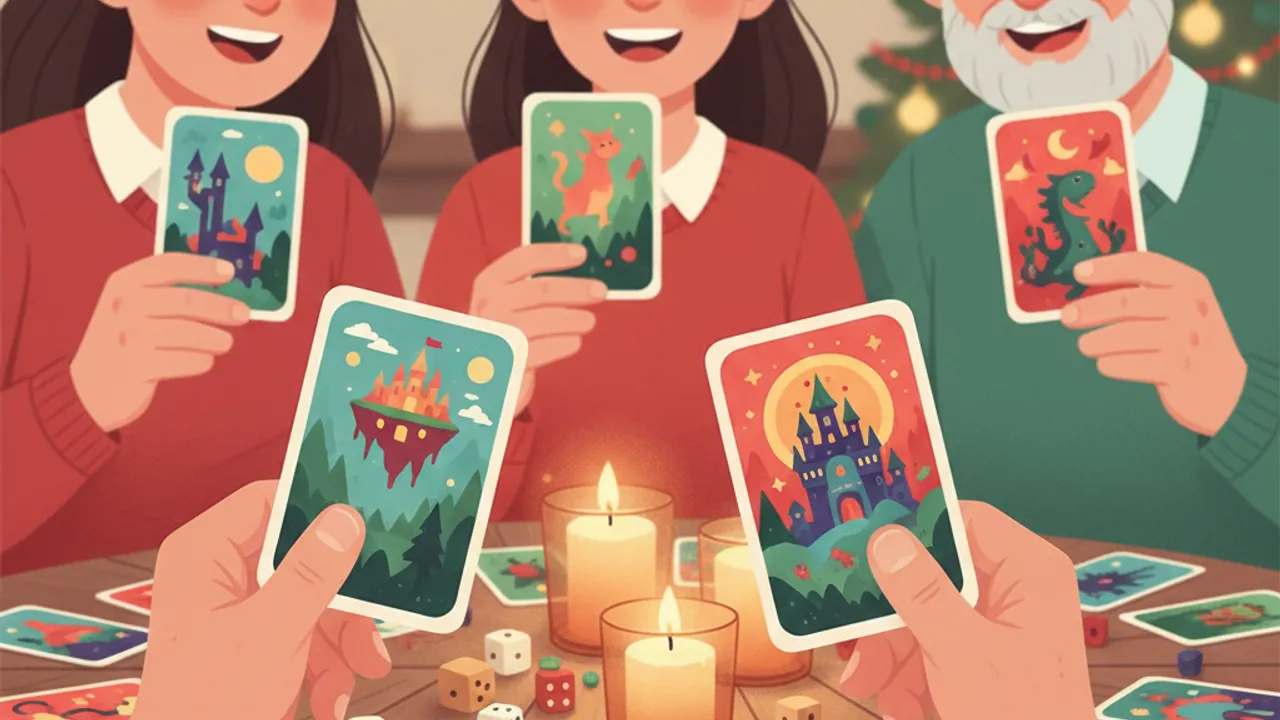
First round. Katja played a card and said: "Monday." Hartmut played a card showing a guy pushing a massive boulder up a hill. Three of us picked Hartmut's card instead of Katja's. "That IS Monday," said Dirk. That's the thing with Dixit: it's about how someone sees the world. Gisela described a card with a woman riding a whale as "Thursday afternoon at grandma's." Ten minutes of conversation about that. Her grandmother always told the wildest stories on Thursdays. I didn't know that. Neither did Sarah. That kind of thing just doesn't happen over coffee and Christmas cake.
Hartmut's descriptions were the driest at the table and simultaneously the funniest. For a house standing upside down he just said: "IKEA bookshelf."
- No language barrier, pictures instead of trivia
- Everyone thinks differently and that's the whole point
- Gorgeous illustrations
- Can feel a bit abstract at first
- Needs at least 4 players for the best dynamic
Codenames for Dessert
What happened next wasn't planned. I pulled out Codenames, "just one round." Teams: Gisela and Katja versus Hartmut, Dirk, and me. Sarah was the moderator. And here I realized something I'd never considered before: when you mix generations into teams, something magical happens. You suddenly have to think about which clues the other generation will actually get.
Katja gave the clue "stream, 2" meaning Netflix and brook. Gisela guessed "river" and "trout." Katja's face? Priceless. "Mom, stream! Like Netflix!" Gisela, completely deadpan: "I know the word, I'm old, not stupid. But trout live in streams." I mean... she's technically not wrong?
On our team Hartmut was the clue-giver. His first clue: "tool, 3." The three words he meant? Hammer, nail, pliers. Zero hesitation. Three seconds, all three correct. Dirk and I cheered like it was the World Cup final. Hartmut just nodded. Classic Hartmut.
- Teams mix up the generations
- Simple rules, deep strategy
- Infinite replay value
- Needs at least 4 players
- Clue-giver role can be intimidating at first
The Poker Face Showdown
It was half past ten, everyone in "one last game" mode, and Katja pulled out her phone. Normally the moment where I mentally roll my eyes. But Katja said: "Everyone, phones out."
Let's Fib. Scan a QR code, 30 seconds later everyone's playing. The explanation fits in one sentence: one person gets the real answer, everyone else makes something up, then you guess who's telling the truth.
And here's where it showed: Hartmut's stoic face, the one that had mildly intimidated me at dinner for three years? In Let's Fib it's a superpower. The question was "What's the most useless kitchen gadget?" Hartmut had the real answer, and his face looked exactly the same as in the rounds where he was bluffing. Zero emotion. Complete poker face. Won four rounds in a row because nobody could tell if he was lying or not.
Gisela on the other hand? Started giggling at her own lies before she'd even finished typing. "I can't lie, I never could!" Didn't diminish the fun one bit. Quite the opposite.
At the end Hartmut held up his phone and said to me: "That's a good game." Hartmut. Praised a phone game. At Christmas. Sarah and I looked at each other like we'd just witnessed a historic event.
- Zero prep, runs in the browser
- Everyone plays on their phone at the same time
- Lying with a straight face is funny across all generations
- Everyone needs a phone with internet
What I Learned
That evening showed me a few things I'd completely misjudged.
It's not the games that matter, it's the order. If we'd started with Codenames, Hartmut would've absolutely stayed on the couch. Just One as an opener set the bar so low that joining in wasn't even a conscious decision anymore. It just happened. And then you're in.
Cooperative before competitive. Always. Especially when people are involved who don't know each other that well or rarely play games. Nobody wants to lose to their son-in-law in the first game of the evening. Or win against them. Both are awkward. Just One sidesteps that entirely because everyone's on the same team.
Short rules beat everything. Gisela's comment about Wingspan wasn't a joke. For people who rarely play, a rules explanation that lasts more than a minute is an instant deal-breaker. By then they're mentally already back at Rummikub.
Games that tell stories connect generations. Dixit uncovered more family stories in one evening than the entire rest of the holidays combined. The pictures trigger memories and suddenly people are talking about things that would never come up otherwise. I wouldn't have believed it beforehand.
Phone games work when everyone's on their phone at the same time. Let's Fib proved that the problem isn't the phone itself, it's when one person stares at their screen while everyone else is playing. When everyone's typing and laughing simultaneously, there's no moment where someone feels checked out. Not even Hartmut.
And the best part? Hartmut asked when we're playing again as he was leaving. Hartmut. THAT Hartmut. Gisela wrote down the names of the games. Katja immediately added Codenames to her wish list. And Sarah looked at me on the way to bed and said: "That was the best Christmas in years."
Sometimes you don't need to bring the most complicated games. Sometimes the right ones are enough. If you're planning your next family evening, our guide on how to plan a game night has more tips.
You might also like
 Nina
7 min read
Nina
7 min read
Making Your Own Game Cards: Crafting, Printing and the Road to Your Own Card Game
How we started making and printing our own game cards. With kids, a laminator, and more ambition than planned.
Read more →
 Stefan
6 min read
Stefan
6 min read
Why Every Board Game Seems to Be "Game of the Year"
Every box in the store carries that red logo. But what's actually behind Germany's Spiel des Jahres, how many games really get the award, and is it worth buying by the sticker?
Read more →
 Ayla
5 min read
Ayla
5 min read
The Game Night Nobody Wanted
Everyone wanted to cancel, nobody had the energy, and in the end it was one of the best evenings in months. Why showing up is always worth it.
Read more →