 Let's
Let's Game Night for 10 People: What Actually Works
10 people, one living room, a whole lot of opinions. Our honest take after one chaotic evening.
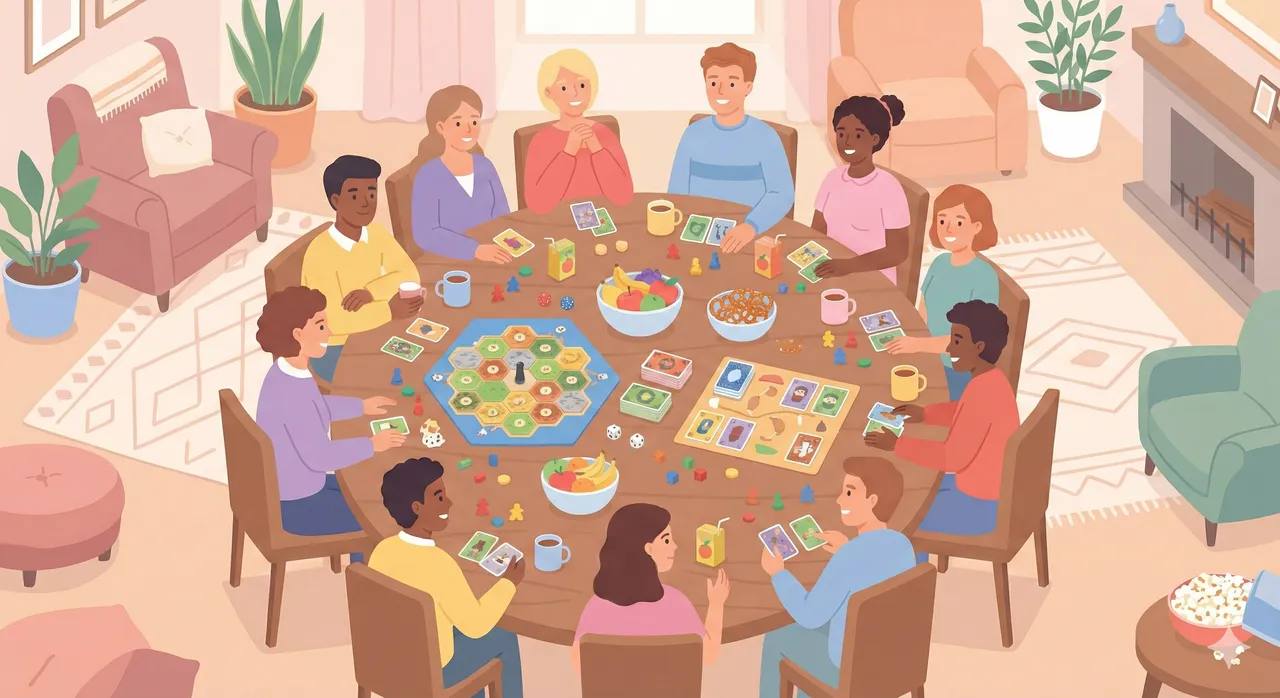
It started so innocently
Last Friday was supposed to be a chill evening. Pizza ordered (four large ones, wouldn't have been enough), drinks in the fridge, a few games on the table. We planned for six people. Ten showed up.
You know that sentence? "I'm bringing someone along." Sounds harmless. It's not. That's the sentence that destroys game nights. At least when you only have games for four to six people on the shelf.
So there we were. Ten adults, a bunch of unsuitable games, and the quiet realization that we had a problem. Since then, we've tried quite a few things. Some were great, some were a disaster, and there's one evening we still prefer not to talk about.
Why 10 people are so tricky
Most games are designed for four to six players. Makes sense, because that's where the dynamics work: everyone gets a turn quickly, nobody gets bored, rounds are short enough. But the moment you double that number, everything falls apart.
- Waiting times. If every turn takes a minute, you're sitting around for nine minutes with ten people. Nine minutes! You could cook dinner in between.
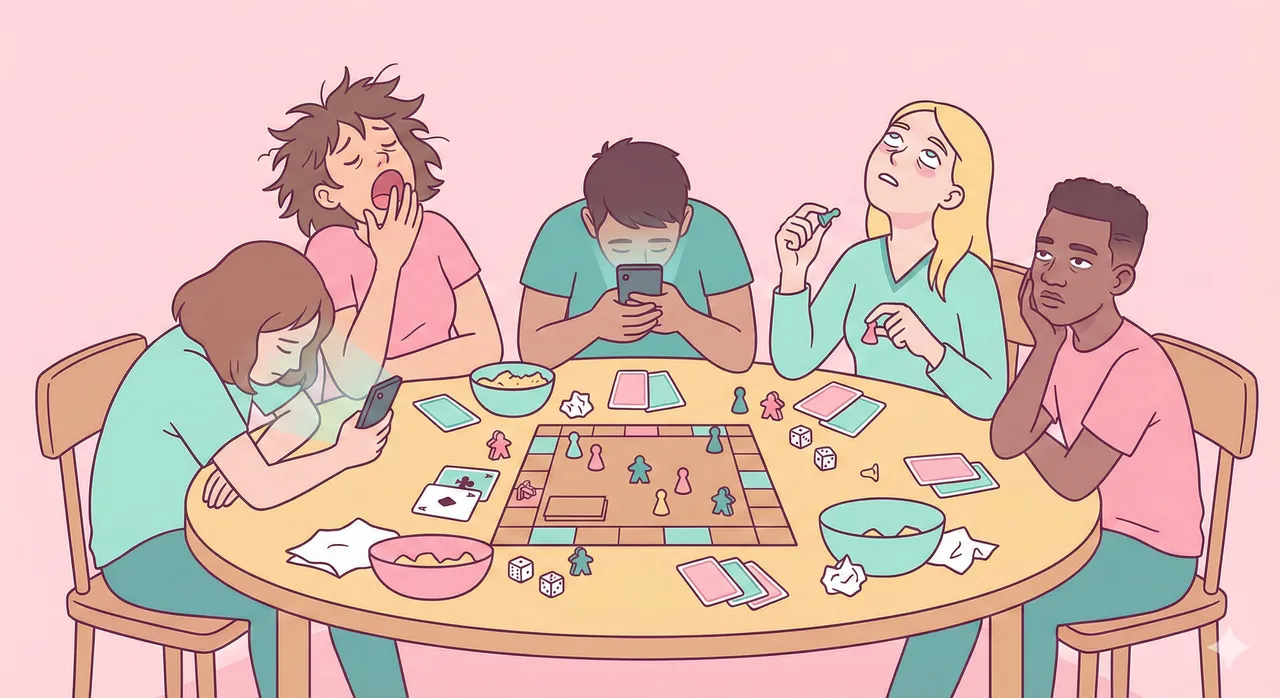
- People check out. After three minutes of waiting, the first person reaches for their phone. After five minutes, half the group is chatting about some Netflix show. The game keeps running somewhere in the background.
- Teams get weird. Five against five sounds fair. But then someone doesn't want to be on Sarah's team because "she always takes forever thinking" and suddenly you're spending 15 minutes debating the team split.
Sounds obvious when you read it like this. But in the moment, on a Friday evening at half past eight, you only notice when it's already too late.
What DIDN'T work
Codenames with 10 people
I love Codenames. I really do. With six players it's one of my absolute favorite games. But with ten? The teams were so big that everyone wanted to talk at the same time. Poor Lisa (sorry again) stood there wide-eyed as the clue giver while five people argued about which word was meant.
After 20 minutes, each team had uncovered exactly three cards. Two people were standing on the balcony. One of them was still in the game.
Okay, to be fair: Codenames can work with big groups. But only if the group is disciplined. Ours isn't. Whose is after two beers?
- Brilliant game concept
- Simple rules
- Too many opinions in large teams
- Long discussions, barely any progress
Werewolf: good idea, wrong group size
One Night Ultimate Werewolf sounds perfect for large groups at first. And it is. But more for 14 or more people. With exactly ten it's this awkward in-between size where it doesn't quite work. The rounds are too short, three people get eliminated in the first five minutes and then just sit around.
Tom started a movie on his phone. In the middle of the living room. Without headphones. His argument: "I'm out anyway." Well. He kind of had a point.
- Exciting role assignment
- Short rounds
- Eliminated players just sit around
- Weird dynamics with exactly 10 people
What DID work
1. Just One
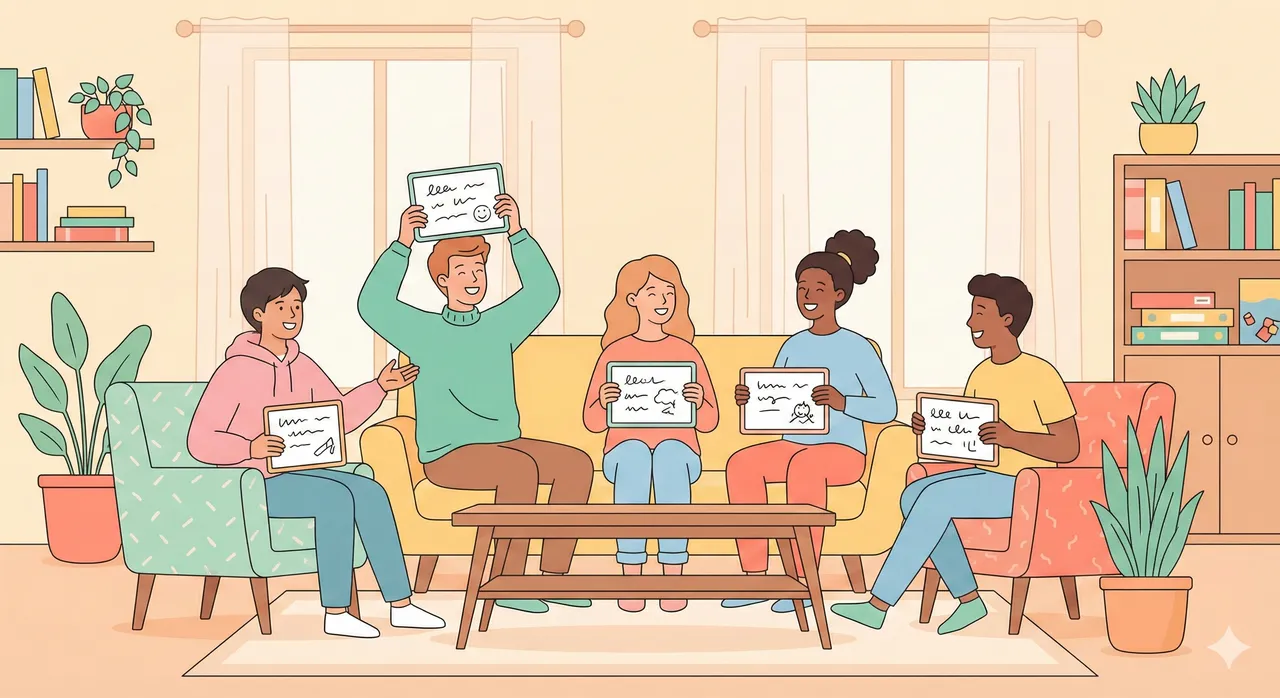
Nobody saw this coming. Just One is technically for a maximum of seven players, at least that's what the box says. We played it with ten anyway and it was easily the highlight of the evening.
The concept: one person has to guess a word. Everyone else writes down a clue. The twist: duplicate clues get eliminated. And that's exactly where it gets funny.
Everyone participates at the same time. Nobody waits. And then that moment when three people had the same clue and they all get crossed out. "You ALL wrote 'yellow'? For BANANA?!" Stefan nearly choked from laughing.
Only downside: it's cooperative. No competition. But after the Codenames disaster, that was honestly exactly what we needed.
- Everyone plays at the same time
- Duplicate clues = guaranteed laughs
- Cooperative, no competition
2. Let's Fib
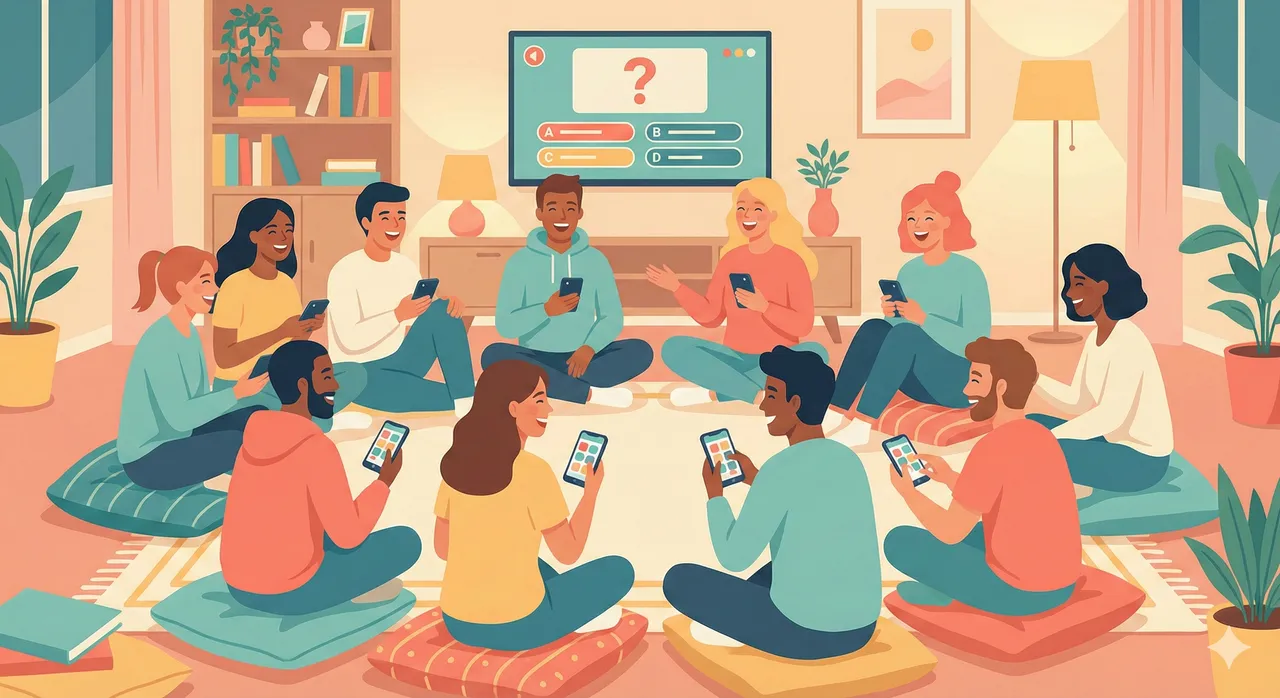
Jens brought this recommendation. Let's Fib runs for free in the browser, everyone plays on their own phone, and everyone plays at the same time. Nobody gets eliminated. No waiting. We must have played five or six rounds, completely lost track of time.
How it works: you get questions and have to trick the others with fake answers. Sounds simple. But it gets really funny because you see who falls for what nonsense. Markus believed the most absurd answer three times in a row. Three times. By the third time the whole room was screaming.
What's also great: no rulebook. Open the browser, enter the code, go. Everyone's playing within a minute. Try that with a board game. If you're looking for games that need no equipment, this is the place to start.
- Free in the browser
- No waiting, everyone plays at once
- Setup in under a minute
- Everyone needs a phone
3. Taboo in teams
Yeah, Taboo. I know. Not exactly original. But you know what? Two teams of five, sitting across from each other, the clue giver standing in the middle, and it just gets loud and funny and chaotic. Sometimes the simple things are the best.
The great thing about Taboo: even when it's not your turn, you're having fun. You laugh at the clue attempts, you groan when someone almost says the taboo word, you shout out the answer even though your team isn't even playing. Eventually nobody follows the rules anymore and it turns into one beautiful mess.
Quick tip: we bumped the timer up to 90 seconds instead of the usual 60. Less stress, more funny moments. Highly recommend.
- Even spectators have fun
- Simple rules, start right away
- Gets loud, warn your neighbors
4. Telestrations
In case you don't know this one: everyone gets a word, draws it, passes the booklet. The next person has to describe the drawing, the one after that draws the description. And so on, until the booklet makes it all the way around.
With ten people the chain is long enough that the results become completely absurd. "Dentist" turned into "man hitting bird with hammer" over six rounds. I have no idea how. The big reveal at the end is always the moment where the loudest laughing happens.
And before anyone says "I can't draw": that's exactly what makes it great. The worse the drawings, the funnier the result. My dentist looked like an angry snowman with pliers. No wonder it turned into a bird with a hammer.
- Long chain = absurd results
- Drawing skills don't matter
- Needs special booklets or lots of paper
Practical tips for large groups
Room setup
Ten people at a dining table is tight. Like, really tight. At some point we pushed the coffee table aside and played on the floor. Sounds stupid, but it was way better. More space, more relaxed vibe. Throw in some cushions and it almost feels like a picnic (just without the ants and with better snacks).
What also works: two game stations. One group at the table with a board game, the other on the couch with something digital. Switch after an hour. If you need inspiration for planning a game night, we've got you covered.
Noise level
Ten hyped-up adults get loud. Really loud. Our neighbor rang the doorbell at half past ten last time. Rightfully so.
What helps: alternate between loud and quiet games. After a round of Taboo (loud) comes a round of Just One (quieter). Gives everyone a break. Including your vocal cords. And your neighbors.
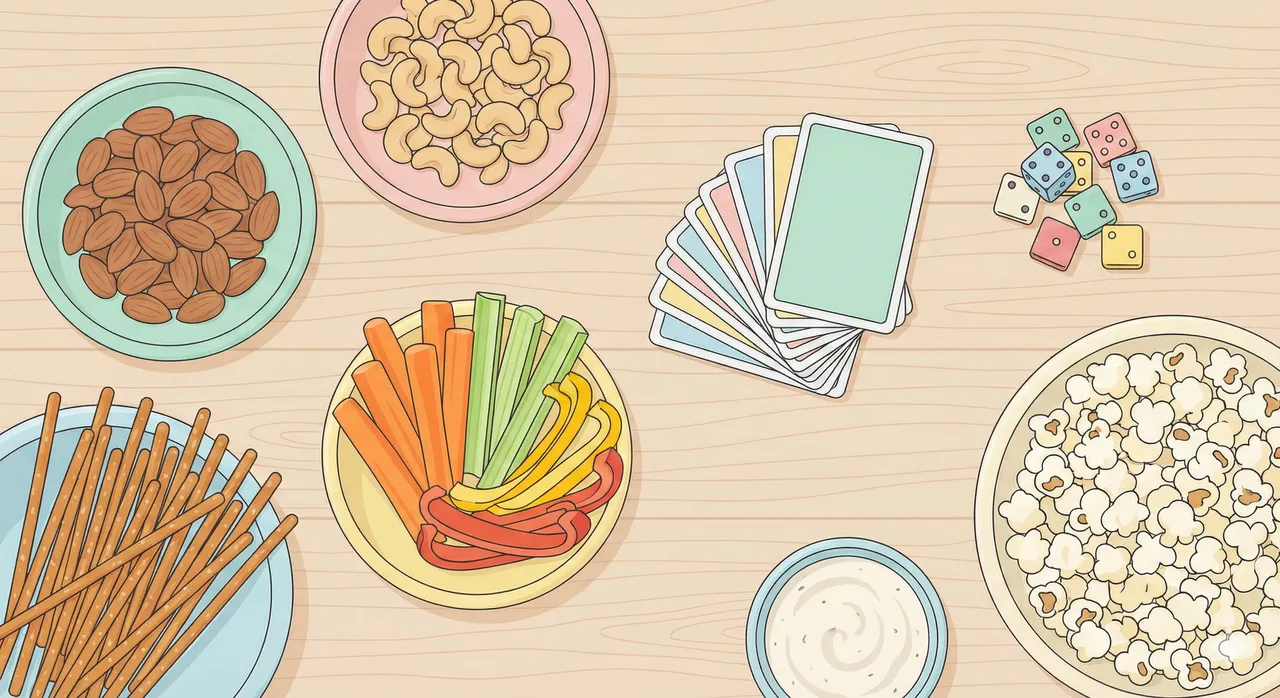
Snacks (underrated!)
Quick tangent because this matters to me: sticky fingers and playing cards don't mix. At our second game night we had nachos with cheese dip. Disaster. The Codenames cards have looked like a crime scene ever since.
What works: nuts, pretzels, veggie sticks, popcorn. Anything you can grab with one hand without your fingers sticking to everything afterwards.
Don't play too long
We learned this at our third game night: 30 to 40 minutes per game, max. Then switch. Even if it's still fun. Better to stop while everyone's still into it than to wait until the first people start yawning. Sounds counterintuitive, but it works.
Our verdict
Ten people are no problem at all. If you have the right games. The most important lesson after five or six game nights at this size: simultaneous play beats turn order. Always. Games where everyone participates at the same time almost always work with large groups. Games with a fixed turn order almost never do.
Next time we're starting straight away with a quick party game instead of trying to stretch some four-player game to ten people (which never works by the way, no matter what the box says). And we're buying more cushions. Definitely more cushions.
Your experiences
What other readers have experienced with large game nights.
"We tried Let's Fib after your recommendation. My husband embarrassed himself so badly that he wouldn't talk about it for a week. It's now a mandatory event at our place."
Maren from Hamburg
"Telestrations with 12 people at a birthday party. 'Firefighter' turned into 'dog wearing a hat on a surfboard'. We spent 20 minutes just looking at the reveals."
Tobias
"The tip about two game stations is worth its weight in gold. We always set up a loud corner and a quiet corner now. The neighbors haven't complained nearly as much since."
Julia & Nico
You might also like
 Nina
7 min read
Nina
7 min read
Making Your Own Game Cards: Crafting, Printing and the Road to Your Own Card Game
How we started making and printing our own game cards. With kids, a laminator, and more ambition than planned.
Read more →
 Stefan
6 min read
Stefan
6 min read
Why Every Board Game Seems to Be "Game of the Year"
Every box in the store carries that red logo. But what's actually behind Germany's Spiel des Jahres, how many games really get the award, and is it worth buying by the sticker?
Read more →
 Ayla
5 min read
Ayla
5 min read
The Game Night Nobody Wanted
Everyone wanted to cancel, nobody had the energy, and in the end it was one of the best evenings in months. Why showing up is always worth it.
Read more →