 Let's
Let's Only Games Under 15 Minutes: Our Experiment
What happens when you spend an entire evening only playing games that take 15 minutes or less? More than you'd think.
The Idea
It started with a perfectly normal problem: not enough time. Markus couldn't make it until nine, Sarah had to leave by half eleven, and Jens had already announced he wouldn't "stay too long" (which with Jens can mean anything between 45 minutes and three hours, you never know).
So: maybe two and a half hours of actual game time. Normally that's enough for one proper board game, maybe two. But somehow I wasn't in the mood for a game where you spend 15 minutes explaining the rules only to realize half the group wasn't paying attention.
Then came the idea. Originally as a joke. "What if we only play games under 15 minutes tonight?" Brief silence. Then Markus: "Seriously?" Yes, seriously. An entire evening, nothing but short games. One after another. Don't like it? Next game. Round over? Next game. Like a tasting menu, just with games instead of canapes.
We actually went through with it. And I'm writing this post because it was one of the best game nights we've ever had.
Our Ground Rules
Before we started, we set three rules:
1. No game can take longer than 15 minutes. If it says so on the box: 15 minutes max. If it doesn't say on the box (digital games, party games): one round has to be doable in 15 minutes. Hard limit. No exceptions. Not even when "everyone's having fun." Especially not then.
2. Rule explanations count towards the time. This was Sarah's idea and it was brilliant. If a game needs five minutes of explaining, you've only got ten minutes left to play. This automatically filtered out games that are technically short but need a whole lecture first.
3. Everyone gets one veto. Once per evening, no justification needed. Jens used his on Dobble right away (more on that later).
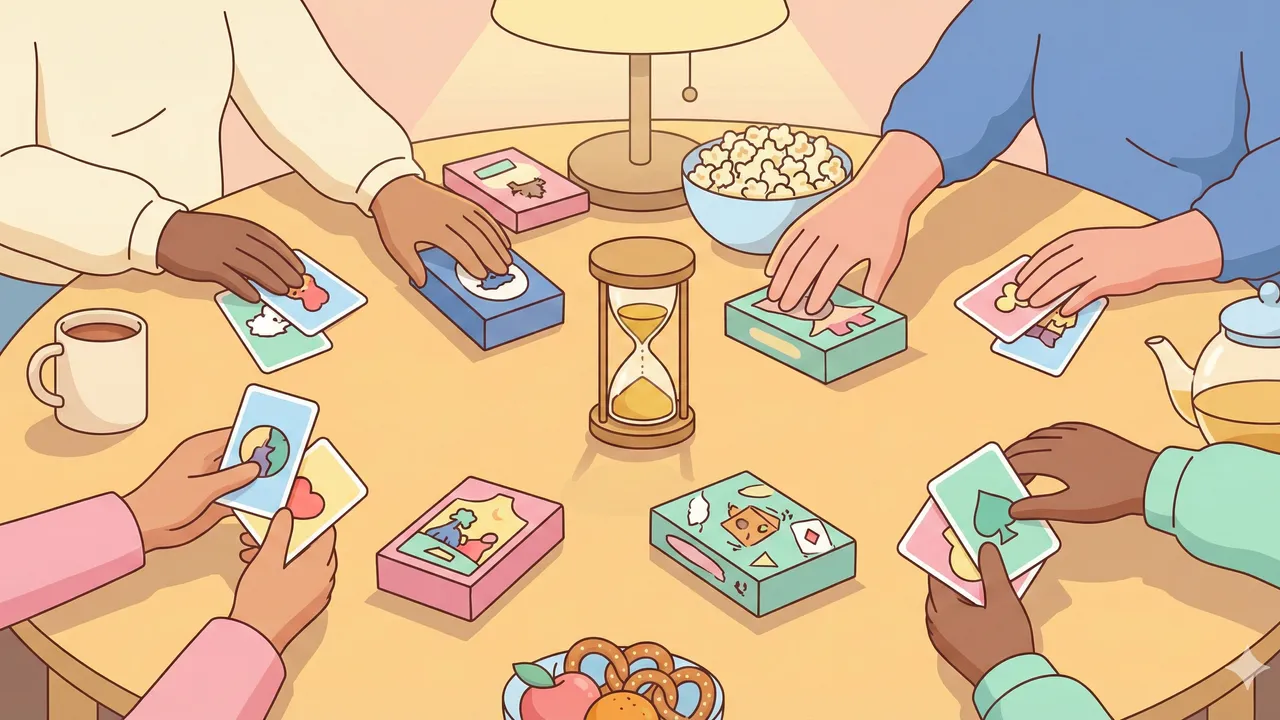
In total we had seven games prepared. We played five of them, some multiple times. And one completely dominated the evening.
How the Evening Went
Quick timeline, because I could barely believe it myself:
9:10 PM -- Everyone's here, drinks on the table. I explain the experiment. Mixed reactions. Markus is skeptical ("Sounds like speed-dating with games"), Sarah likes it, Jens shrugs.
9:15 PM -- First round of Take 5 as a warm-up. Rules explained in two minutes, done after eight minutes. Everyone's grinning. "Okay, next one."
9:25 PM -- Love Letter. Jens wins three rounds in a row. Plays the Prince at the perfect moment every time. Markus suspects cheating. (It wasn't. Jens is just impossibly good at bluffing.)
9:45 PM -- Coup. This is where it gets loud. Sarah eliminates everyone in under five minutes. "I just lied. Every single time." Respect.
10:00 PM -- First time playing Let's Fib. Silence. Then laughter. Then chaos. Then again. And again.
10:45 PM -- We're still playing Let's Fib. Nobody wants to stop.
11:10 PM -- Sarah has to leave. "Too bad, I could have kept playing." Sarah. The one who had to leave by half eleven. It's ten past eleven and she thinks it's too bad.
That pretty much says it all.
Let's Fib (the secret star)
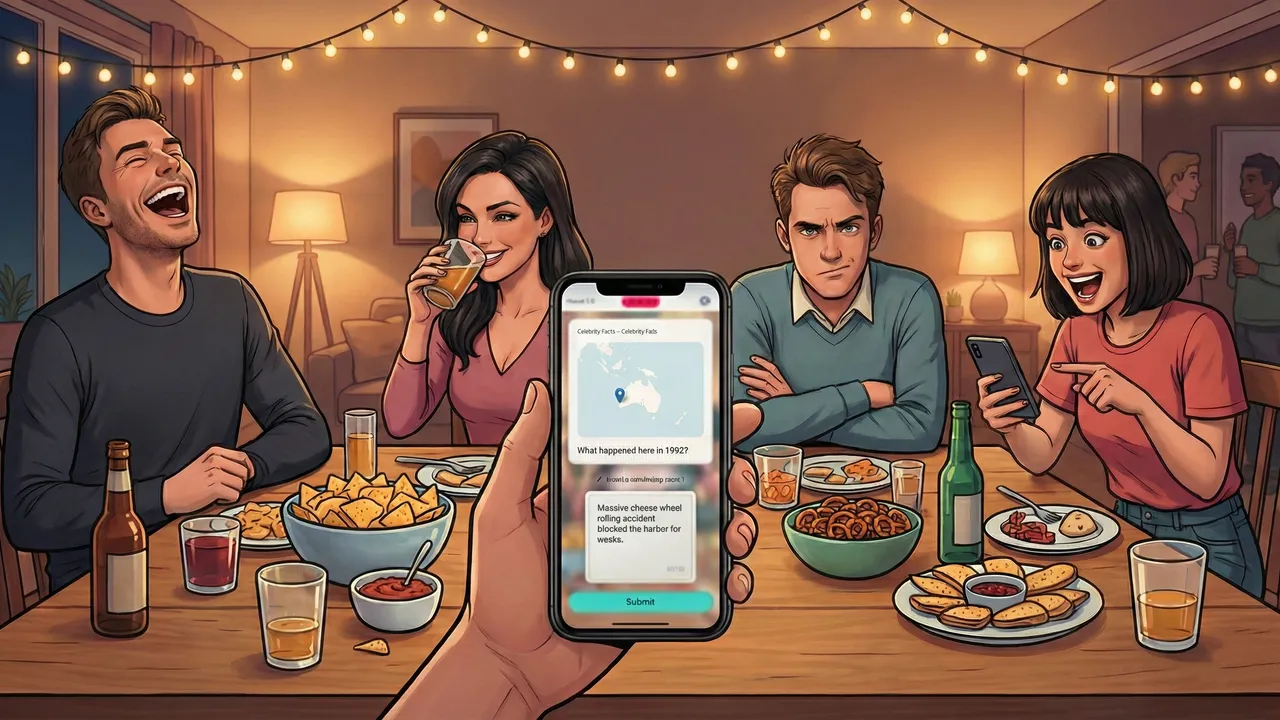
I need to go into more detail here, because Let's Fib completely took over the evening. And that despite (or maybe because?) it's not technically a classic game.
For those who don't know it: you play in the browser on your own phone. There's a question and all players write a fake answer. Then the real answer and the made-up ones are shown together, and everyone has to guess which one is true. If someone falls for your fake answer, you get points. If you spot the real answer, you also get points.
Sounds simple. It is. And that's exactly the point.
What happened with us: Markus wrote such an absurd answer to a geography question that everyone thought it HAS to be the real one. It wasn't. He scored more points in one round than I did the entire game. The look on his face: priceless. That self-satisfied grin of someone who just fooled six people at once.
What made Let's Fib so perfect for this evening:
Setup in seconds. Open browser, enter code, play. No app to download, no account, nothing. For an evening with lots of short games, that's worth its weight in gold. You spend your time playing instead of preparing.
Every round is different. We must have played eight rounds and none of them felt like a repeat. New questions, new creative lies, new moments where the whole room erupts. Anyone looking for party games for your phone will find what they need here.
It gets personal (in a good way). You learn things about your friends. For instance that Jens apparently knows every conceivable answer to physics questions but is completely lost on pop culture. Or that Sarah can lie so convincingly that it honestly scares me a little.
No elimination. Everyone plays the whole time. Nobody sits around. After the Coup debacle (where Markus got knocked out in round two and then spent five minutes inspecting his fingernails), that was a welcome change.
The only downside: you don't stop. Seriously. "Just one more round" is the most dangerous sentence of the evening. We played Let's Fib for 45 minutes straight. On an evening that was supposed to consist entirely of 15-minute games. The irony wasn't lost on me.
- Free in the browser
- Every round different and surprising
- Works with any group size
- Addictive (one round is never enough)
The Other Short Games
Take 5
Take 5 was our opener and the perfect choice for it. Everyone plays a card simultaneously, then you resolve. No waiting, quick rounds, and that wonderful feeling when you play the perfect card and someone else has to collect the bull heads.
What I like about Take 5: you can genuinely explain it to anyone. "Play a card. Low is good. Sixth card in a row is bad." Done. Grandma gets it, the mate who "doesn't like games" gets it, and after two rounds everyone has a strategy (which usually doesn't work, but that's part of the charm).
This evening it was the perfect opener. Ten minutes, everyone was in, the mood was set. An opener doesn't need to do more than that.
- Everyone plays simultaneously
- Rules explained in 2 minutes
- Works great even with many players
- Sometimes pure luck
Love Letter
Okay, Love Letter is a small miracle. 16 cards. The entire game consists of 16 cards. And yet you sit there genuinely deliberating whether to play the Priestess or the Baron. It's absurd how much tactics fit into so little material.
Jens absolutely schooled us. Completely. He held onto the Princess for three consecutive rounds without anyone catching him. His technique: "I just look bored." That's his bluffing strategy. Looking bored. And it works. Every. Single. Time.
Only downside for our evening: maximum six players. We were only five, so no problem. But for larger groups it's out.
- 16 cards, yet surprisingly deep
- Bluffing element keeps things tense
- Fits in any pocket
- Maximum 6 players
- A bit thin with just two
Coup
Coup is Love Letter for people who love lying. You have two cards representing roles (Duke, Assassin, Captain, that sort of thing) and you simply claim you have whatever you need. Is it true? Who knows. Does anyone believe me? Hopefully.
The thing about Coup: it escalates absurdly fast. In our second round, Sarah claimed on her very first action that she had the Duke (she didn't), collected income, and then next round eliminated everyone with the Assassin (she actually had that one). Five minutes, done. We sat there with our jaws on the floor.
Problem: if you get knocked out early, you just sit there. Markus got exactly one turn in one round before he was out. "Great game," he said. He didn't mean it.
Still: for those quick, intense moments, Coup is unbeatable. You just have to live with the fact that some rounds are over in three minutes.
- Pure bluffing, every round different
- Quick eliminations keep tension high
- Eliminated players wait briefly
- Needs at least 4 players
Dobble (the veto game)
We played exactly one round of Dobble. Then Jens used his veto. "It makes me dizzy." Fair enough. It's a reaction game where you have to find the matching symbol on round cards, and yes, it's hectic. Very hectic. The one round was fun, but I get why it's not for everyone.
What surprised me: Dobble is LOUD. Five adults simultaneously screaming "CACTUS!" is quite the experience. The neighbors were probably thrilled.
- Reflexes over strategy
- Understood instantly
- Gets repetitive after 3 rounds
- Not everyone enjoys the frenzy
What We Learned
This experiment revealed a few things I didn't expect:
Short games aren't "less valuable." That was my biggest prejudice going in. I thought an evening of nothing but short games would feel like appetizers without a main course. Wrong. Completely wrong. The variety made up for it. You experience so many different moods, dynamics, and moments in one evening that it actually feels fuller than three hours of Catan.
Player swaps happen naturally. Someone needs the bathroom? No problem, we'll play a round without you, you jump back in for the next game. It was so relaxed. No more "we have to wait or the game won't make sense." People came and went and it just worked.
The best moments were between games. Sounds paradoxical, but the 30 seconds between two games were often the funniest. "What WAS that just now?" "I can't believe you fell for that." "Again, again, again." Those little debriefs, laughing together about the nonsense you just experienced.
Not every short game works. Dobble was too hectic, Coup has downtime issues. The winners of the evening were all games where nobody gets eliminated and everyone plays simultaneously. Let's Fib out front, Take 5 as a solid second.
15 minutes is the perfect limit. Not 10 (too short, you can't get into it), not 20 (then those "short" board games that actually take 40 minutes start sneaking back in). 15 minutes is the sweet spot where a game can have enough depth but never drags on. If you're thinking about planning a game night, keep a few short games in mind as a format experiment.
Are we doing this again? Absolutely. Not every time, Catan and Carcassonne still have their place. But as a format for evenings with limited time or mixed groups, the 15-minute experiment is now a permanent fixture in our rotation.
If you want to try it yourselves: start with Let's Fib and Take 5. Seriously. That's all you need to get going. You'll figure out the rest over the course of the evening.
Your Short Game Tips
What do you play when time is tight?
"We've been playing nothing but Let's Fib as a warm-up for months now. By this point the warm-up usually lasts longer than the actual game afterwards. Nobody's complaining though."
Kai from Dusseldorf
"Take 5 is our secret weapon for family gatherings. Grandma gets it instantly and wins most of the time. No idea how she does it."
Anna & Tim
"Coup with our flatmates is the reason we don't trust each other anymore. In the best way possible. Yesterday Mara claimed she had the Duchess. For the fifth time in a row. She didn't."
Lena
You might also like

 Nina
7 min read
Nina
7 min read
Making Your Own Game Cards: Crafting, Printing and the Road to Your Own Card Game
How we started making and printing our own game cards. With kids, a laminator, and more ambition than planned.
Read more →
 Stefan
6 min read
Stefan
6 min read
Why Every Board Game Seems to Be "Game of the Year"
Every box in the store carries that red logo. But what's actually behind Germany's Spiel des Jahres, how many games really get the award, and is it worth buying by the sticker?
Read more →
 Ayla
5 min read
Ayla
5 min read
The Game Night Nobody Wanted
Everyone wanted to cancel, nobody had the energy, and in the end it was one of the best evenings in months. Why showing up is always worth it.
Read more →